FAQ's
You have questions. We have answers.
Frequently Asked Questions
That choice is completely up to you.
Some people prefer the convenience of participating in therapy from the comfort and privacy of their own home (or even their car!). As long as you have a confidential space to meet with your provider, online works great.
Others would rather meet with their counselor or psychiatric provider face-to-face. Some people say it feels more personal. Our offices in Naperville and Batavia are welcoming and comfortable, and we would be happy to see you there.
Most of our team members are “hybrid” – meaning they do some days in the office and some working remotely. You can talk with your provider about your options, even alternating between in-person and online.
We do! We accept the Medicaid plans listed in the next FAQ below. If you have a different type of Illinois Medicaid, we cannot bill Medicaid for your services. Locally, we refer to Family Counseling Service (630-844-2662 or www.aurorafcs.org). If that’s too far from your home, we can help you find a closer provider who accepts Medicaid.
We do! We currently accept the following insurance plans:
- Aetna
- Aetna Better Health (Medicaid)
- Ambetter
- BCBS PPO
- BCBS HMO – Advocate
- BCBS HMO – Pathways (Amita Health)
- Blue Cross Community (Medicaid)
- BCBS MMAI (Medicare/Medicaid)
- Cigna/Evernorth
- CountyCare (Medicaid)
- Magellan
- Medicare
- Meridian Health Plan IL (Medicaid)
- Molina Health (Medicaid)
- UMR
- United Health Care/Optum
- YouthCare (Medicaid)
If we are OUT OF NETWORK with your insurance, we encourage you to contact your insurance company and ask about “out of network benefit” coverage. Some insurances will allow you to see us out of network, and you’ll likely just have a slightly higher copay or coinsurance. You also have the option of paying cash for services (see next FAQ below). Sometimes you are able to submit your payments back to your insurance company for reimbursement using what’s called a “superbill” that we can provide.
We offer a sliding fee scale for clients who are seeing one of our providers who is not in their insurance network, and for people who may not be able to afford our regular fees.
We may be able to reduce your costs based on your circumstances. Reach out to us if you want to begin services but are concerned about your ability to afford mental health care.
You’ll meet with a clinical professional and complete an assessment. This helps you and our team member clarify exactly what you’re hoping to accomplish and develop a plan to get you there. You’ll also start the process of deciding if your therapist is the right one for you!
Our approach recommends therapy and psychiatry together. Study after study shows that people get better faster, with longer lasting improvement, when participating in both kinds of treatment together. That being said, we do sometimes allow clients to just see a medication provider. If that’s the case for you, understand that your medication provider may recommend at a later time that you restart therapy services. It’s important for you to know that we do almost always ask someone seeking medication services to first see one of our therapists for a full mental health assessment. This helps gather some of the information the medication provider will need, requiring less of their time, and keeps costs lower for you.
That’s ultimately up to you. Your counselor or medication provider will make a recommendation, but how often you schedule with us is ultimately your decision. Many people start with weekly sessions, then reduce the frequency of appointments as their goals are being met. For psychiatry, your provider may want to see you once a month (or more if you’re really struggling) at the beginning. Most people who are doing well on their medications are only seen every 2 or 3 months.
Because change is hard! Even thinking about putting in the work to make change in our lives can be stressful. Plus, let’s be realistic; you don’t really know us yet. We just ask that you grace us with a small amount of trust at the beginning. You’ll be glad you reached out.
It’s a little bit complicated, but it’s all about the seriousness of the problem for which you’re seeking help.
Wellness screening can be thought of as a mental health “check-up.” Maybe you work a stressful job, or you’re just not feeling like yourself emotionally. Wellness screening involves meeting (sometimes just once) with a mental health professional to assess several important areas of your life – how you’re handling stress or anxiety, your mood, substance use, relationship quality, work performance, etc. It may result in your just getting a few helpful tips on how to do and feel better, or it may end up with you getting a referral for ongoing services.
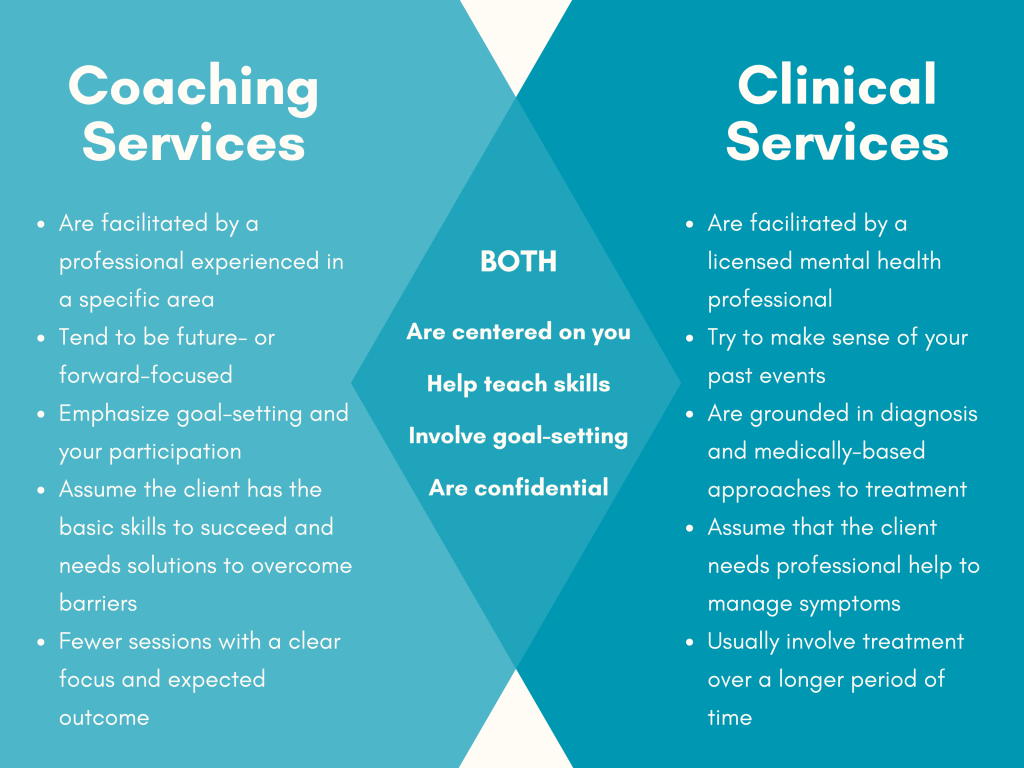
Coaching is working one-on-one with a mental health professional to address specific goals you have. They may be goals related to parenting, a relationship, career, or more. Coaching is usually shorter-term.
Therapy is you and mental health professional completing an assessment and developing a plan to improve your life in the areas for which you came to therapy. It could be for anything – a better marriage, improving a child’s behavior, or learning to manage the symptoms of a mental health condition like anxiety. You’ll usually meet more often and for a longer period of time than with coaching.