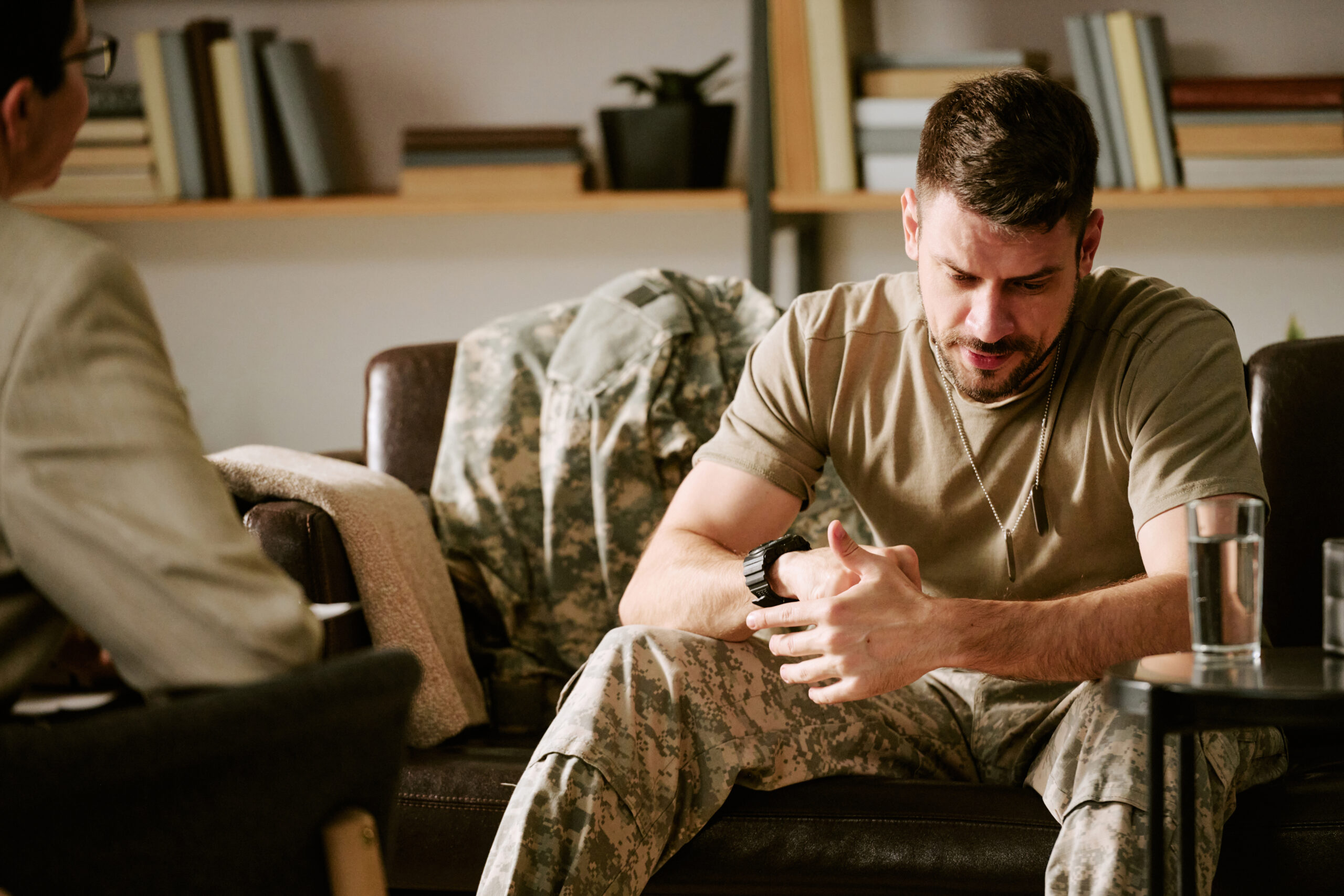
When members of the military and first responders are considering seeking mental health care, the questions people actually want answered rarely make it into the appointment.
Will my command find out? Will this end my clearance? Will they take my gun? Does this go in a file somewhere? What happens when I have to renew? And underneath all of it: does needing this mean I’m not who I thought I was?
These are reasonable questions and they deserve direct answers rather than reassurance. Here’s what I can tell you.
“Will my command or my department find out?”
The honest answer is that it depends on your situation, and you’re entitled to know exactly which rules apply to you before you disclose anything.
For service members, DoD policy is built around the principle that voluntary mental health care stays confidential, with specific enumerated exceptions. Command notification is required when a provider believes there’s a serious risk of harm to self or to others, a serious risk of harm to a specific mission, when the evaluation was command-directed, when inpatient care or certain acute situations are involved, and in a small number of other defined circumstances. Even then, policy directs providers like me to disclose the minimum information necessary — not your full history.
Substance use records carry additional federal protections beyond ordinary medical privacy, and self-referral for substance misuse is handled under its own set of rules.
For police, fire, and EMS, there is no single national policy. It varies by department, by contract, and by state. What’s true almost everywhere: voluntary personal therapy with a private provider is not the same thing as an employee assistance program visit, and neither is the same as a fitness-for-duty evaluation. Those are three different processes with three different sets of rules about who sees what.
The question to ask any provider, in the first phone call: Who is your client here — me, or my agency? What would require you to tell someone, and who would that be? A good clinician answers this plainly and isn’t offended you asked.
“What about my security clearance?”
This is the fear that keeps the most people out of treatment, and the reality is less severe than the rumor.
Question 21 of the SF-86 asks whether, in the last seven years, you’ve consulted a health care professional about an emotional or mental health condition, or been hospitalized for one. The form’s own instructions carve out several categories that can be answered “no,” including counseling strictly related to adjustment from combat service, marital or family counseling not related to violence you committed and not court-ordered, grief counseling, and counseling received as a victim of sexual assault relating to that assault.
The government’s stated position is that seeking care is not the concern — an untreated condition affecting judgment or reliability is. Federal guidance has been explicit that proactive management of mental health is viewed favorably, and that an applicant can’t be denied an interim clearance solely for answering “yes” to Question 21.
What actually creates clearance problems, far more often than treatment, is the wreckage that accumulates when nothing is treated: the DUI, the financial mess, the domestic incident, the pattern of workplace conduct.
Important caveats. These rules change, they vary by agency, and specific duty statuses — flight status, certain special programs — have their own requirements. Nothing here is legal advice. Read the current form and its instructions, follow your agency’s guidance, answer truthfully, and if your situation is complicated, talk to an attorney who does clearance work.
Note for PsycHelp: this section should be reviewed before publishing and re-checked periodically, since the form and guidance are updated. Consider having your attorney glance at it.
“Some medications will affect my duty status, won’t they?”
Some can, depending on your role. Deployment eligibility, flight status, and certain assignments carry medication restrictions that don’t apply to the general public.
This is a reason to raise the topic in the first appointment, not a reason to avoid treatment. Tell your prescriber what your job requires. There is usually more than one reasonable option, and the choice can be made with your career in the room rather than discovered afterward.
The culture problem
Every institution here runs on a version of the same idea: you handle it, you don’t complain, and whatever you feel stays contained. That belief isn’t stupid. It’s load-bearing. It’s what lets people run toward things that everyone else runs away from, and function on a scene that would flatten a civilian.
The trouble is that the ability to switch it off was never included in the training.
So it stays on. It runs at home, during your kid’s birthday party, at 3:00 am when you’re staring at the ceiling. The skill that keeps you alive at work quietly ruins everything outside of it, and because the whole culture treats that as normal, nobody names it for years.
A few things worth saying plainly:
Suppression is a tactic, not a treatment. It’s the right call in the moment. It was never designed to be a twenty-year strategy.
Sleep is usually the first thing to break, and the first thing worth fixing. Chronic sleep disruption degrades judgment, emotional regulation, and impulse control — the exact capacities this work demands.
Depression and PTSD are injuries, not character defects. Nobody in these professions thinks a torn ACL means you were weak. The brain gets the same courtesy.
Medication is not a personality transplant. It doesn’t blunt you or make you soft. Done right, it turns down the volume on symptoms enough that you can function — and if it makes you feel flat or dulled, that’s a wrong dose or wrong medication to report, not something to accept quietly.
The drinking
It has to be addressed, because leaving it out would make everything above dishonest.
Alcohol is the sanctioned coping mechanism in every one of these cultures. It’s built into the schedule — after shift, after the call, at the unit function. It works in the short term, which is exactly the problem, and it is the most common reason people never find out whether treatment would have helped.
Three things matter here:
It undermines the treatment directly. Alcohol fragments sleep, worsens depression and anxiety over time, and blunts the effect of psychiatric medication. Treating depression while drinking heavily often looks like a medication failure when it isn’t.
Your prescriber needs to know the real number. Not the socially acceptable one. Some medications are unsafe combined with alcohol, and some prescribing decisions change entirely based on an honest answer. This is a safety issue rather than a judgment, and a good prescriber has heard it all before and won’t flinch.
Cutting back isn’t a prerequisite for making the call. Plenty of people find that the drinking eases on its own once sleep and mood are treated. You don’t have to arrive already fixed.
What I’d suggest asking at a first appointment
- Who is your client, and what would require you to notify anyone?
- Have you worked with military or first responders before?
- My job has these requirements — how does that affect what you’d consider prescribing?
- What are we targeting, and how will we know if it’s working?
- What’s the plan for reassessing this later?
- Can you work around my schedule and rotations?
Working with PsycHelp
Our practice also includes Kim Johnson, LPC, who worked patrol for 20 years before two decades of clinical practice.
Counseling and psychiatry sit in the same practice here, which should matter to you. Medication and therapy work better together, and the coordination doesn’t fall to you. We offer evening and weekend appointments for people on rotating schedules, telehealth throughout Illinois, and offices in Naperville and Batavia.
Contact us or call (630) 999-8404.
Confidential support, right now:
Veterans Crisis Line — call 988 then press 1, or text 838255.
CopLine — 1-800-267-5463. 24/7, answered by trained retired law enforcement officers. Callers may remain anonymous.
Safe Call Now — 206-459-3020. Confidential support for first responders and their families.
988 Suicide & Crisis Lifeline — call or text 988, any time.
This article is general education, not legal advice, security-clearance guidance, or medical advice about your situation. Policies vary by branch, agency, and duty status and change over time — verify current requirements through official channels.